Told from Above · a Shramko 360 series
 Author: Andrii Shramko
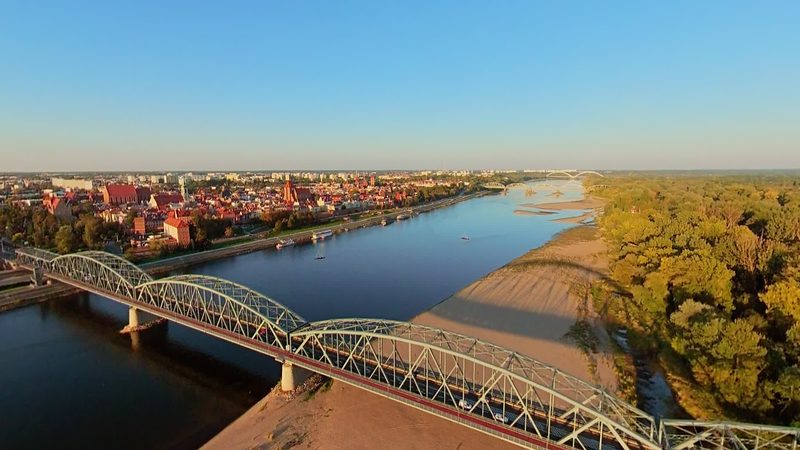
Dybów Castle and the Piłsudski Bridge, Toruń — a guided 360° flight
- 3 min
- 360° · 8K
- Open captions
- Online since 17 October 2026
Toruń demanded that a rival town be moved up the Vistula, because it was taking away its trade.
About the film
That town was Nieszawa, which stood next to Dybów Castle on the left bank. The people of Toruń gave the Polish king an ultimatum: trade privileges and the destruction of Nieszawa in return for becoming his subjects. Its inhabitants were moved upriver, where Nowa Nieszawa grew. In this film I fly over Toruń's left bank.
The guide tells, among other things, whose name, according to a poll, the Józef Piłsudski Bridge was meant to bear. One more story from the film: in September 1939 the Polish Army blew up the bridge, and trams from Podgórz to Toruń ran across it until 1984.
If you are ever in Toruń, cross the bridge to the left bank and the ruins of Dybów Castle. Władysław Jagiełło began building the castle in 1424.
Places in the film
- Dybów Castle (Zamek Dybowski) Map
- Józef Piłsudski Bridge Map
- Podgórz Map
- Piaski Map
- Left bank of the Vistula Map
The guide's full text (English)
Dybów Castle is the red brick square just below us. Who built it? Władysław Jagiełło, starting in 1424. Long after him, French troops under Lieutenant Savary held out in it against the Russians for months.
What did Toruń, the red-roofed town across the river, want from a king? Its burghers gave the Polish king an ultimatum: trade privileges and the destruction of Nieszawa, in return for becoming his subjects.
Why did a whole town have to move? Nieszawa stood beside Dybów Castle and competed with Toruń for trade. At Toruń's demand, its people were moved up this river, the Vistula, where a new town grew: Nowa Nieszawa.
On what did Kersten base his decision? Kersten argued for it: Toruń Główny, the main station, stood on the left bank, and the bank would bring in property tax. Ahead, the Józef Piłsudski Bridge comes into view.
Did the left bank want to join Toruń? Not yet. The town of Podgórz, on this side, talked with Toruń about a bridge with trams and about joining the city, then broke the talks off in 1923.
What would you call a bridge, if asked? In a poll, 994 votes went to Copernicus, Mikołaj Kopernik. The steel arches right beside us are the Józef Piłsudski Bridge. On 7 September 1939, the Polish Army blew it up.
How did the rival bank finally reach the city? By tram. Trams first crossed the new bridge on a Christmas Eve, and ran from Podgórz into Toruń, toward the Old Town straight ahead, until 1984.
In the end, Piaski became part of Podgórz, and then Podgórz itself was joined to Toruń, the city ahead.
How the film was made
8K (7680×3840), 60 fps. Open captions in English, burned into the picture: three copies around the view, one next to the place being described. Narration: a synthetic voice in English.
The guide's facts come from:
Back to all filmsFor the cityFilms for deaf and hard-of-hearing viewers
Andrii Shramko
Engineer and filmmaker, living in Bydgoszcz. I have been filming 360° in motion since 2015.