Told from Above · a Shramko 360 series
 Author: Andrii Shramko
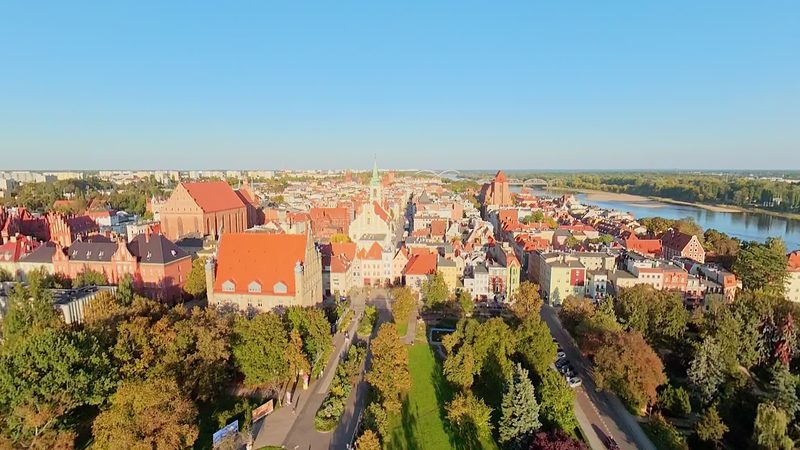
Old Town and the Church of the Holy Spirit, Toruń — a guided 360° flight
- 7 min
- 360° · 8K
- Open captions
- Online since 13 October 2026
The Lutheran Church of the Holy Spirit in Toruń had to look like a modest townsman's house.
About the film
Toruń's Lutherans kept losing their churches: the Jesuits took St John's from them, and after the Toruń Tumult of 1724 they lost St Mary's too. In this film I fly over the Old Town, Artus Court and the Church of the Holy Spirit.
The guide tells, among other things, who guarded St Mary's Church during the Corpus Christi procession, and why the Harmonijka office block has armoured doors in its basement. One more story from the film: the House Under the Star (Kamienica pod Gwiazdą) once belonged to the humanist poet Callimachus, tutor to the sons of King Casimir Jagiellon.
If you are ever in Toruń, look at Artus Court. After the Tumult, the Lutherans prayed in the cramped hall of the earlier building on this site until 1756.
Places in the film
- Old Town (Stare Miasto) Map
- Church of the Holy Spirit Map
- Artus Court (Dwór Artusa) Map
- St Mary's Church Map
- House Under the Star Map
The guide's full text (English)
Could a king keep Luther out? Ahead lies Toruń's Old Town. Its first Protestants appeared soon after Martin Luther's theses, and King Zygmunt the Old issued edicts in Toruń banning the import and spread of Luther's writings.
Did the ban hold? Later, King Zygmunt August granted the town a privilege allowing the Lutheran faith to grow, and Toruń became one of the leading Protestant towns of the Commonwealth, where a general synod of Protestants met.
Why would an office building need armoured doors? The long grey ribbed block below is Harmonijka, the Accordion, designed by Jerzy Wierzbicki where the town walls stood. Its basement got safes behind armoured doors for a savings bank.
When the Jesuits arrived to drive the Counter-Reformation, they seized the Church of St John. The city fathers tried to limit the Catholic influx, but Catholics already held most churches, leaving the townspeople of the other faith only St Mary's.
Could the two faiths talk it out? As tensions between Catholics and Protestants grew, the leaders of the rival creeds met for a Colloquium Charitativum, a discussion that resulted in no agreement.
Who guarded St Mary's during processions? A Lutheran Bürgerwehr, a citizens' militia: at every Corpus Christi procession it had to guard the church, as the gathered Catholics might have occupied it as well.
Why is the street here called the Moat? Collegium Maximum, the sandstone front with a statue on top, was designed by Julius Habicht, head of the Reichsbank's building office, on a filled-in moat, hence Fosa Staromiejska.
At a Jesuit procession, pupils of the Jesuits accused the Lutherans watching of insulting Holy Mary, keeping their hats on and not kneeling before her statue, and in the quarrel the Lutheran militia arrested a Catholic student, Stanisław Lisiecki.
Who was the Caesar of Caesar's Arch? Łuk Cezara, the house with an arched passage, blocked the road to the Bydgoskie Przedmieście suburb until a German architect, Karl Cäsar, cut through it, and the arch took his name.
Unable to make the town authorities free the detained, students of the Jesuit College kidnapped Jan Nagórny, a pupil of the Academic Gymnasium, a chance victim with no part in that quarrel.
Whose church was this? The brick church with the enormous red roof is St Mary's, the Marienkirche, which began as a Franciscan church. Protestants held it from the year 1557, and in the year 1724 it passed to the Bernardine friars.
Can a church be disguised as a house? Below us, the Church of the Holy Spirit, cream, with a green spire. King August banned it at first, then in 1754 allowed only a prayer house shaped like a modest burgher's home.
Whose palace stood here? Below is Poczta Główna, red brick with corner turrets. After the 1703 Swedish siege wrecked this side of the square, palaces rose here, home to mayors such as Samuel Luther Geret.
Who signed for this town hall, and when? The Old Town Hall, brick with stepped gables, was probably built by a master named Andris, and Grand Master Konrad von Wallenrode signed its building permit only when construction was already under way.
After a crowd wrecked the Jesuit College, the Polish supreme court ordered executions: Mayor Johann Gottfried Rösner and nine other Lutheran officials were blamed for neglect of duty, sentenced to death, and executed on 7 December 1724.
Where do you pray when your church is taken? In Artus Court, the red brick front with arched windows: after the 1724 riot, the Toruń Tumult, the Lutherans, stripped of St Mary's, held services in its cramped hall until 1756.
Which poet tutored a king's sons? Below, the golden star marks Kamienica pod Gwiazdą, the Star House. It once belonged to the humanist poet Kallimach, tutor to the sons of King Kazimierz Jagiellończyk.
Did anyone escape the sentence? A convict who converted to Roman Catholicism was spared, and so was Rösner's predecessor, the respected historian Zerneke, author of the Chronica Thornica, who was amnestied and left for Danzig.
Whose heart lies in this church? By the river, St John's, the Johanniskirche, shows its massive tower. When Polish King John Albert died in Toruń in the year 1501, his heart was buried here.
Did Europe hear of the sentences? Hundreds of newspapers reported on the alleged oppression of Protestants in Thorn, and decades later Voltaire recalled the sentencing as an example of the religious intolerance of the Poles.
How is the day of the executions remembered? That day, Franciscan friars said mass in St Mary's, the last Protestant church; 7 December is now observed in remembrance of the Protestant martyrs.
How the film was made
8K (7680×3840), 60 fps. Open captions in English, burned into the picture: three copies around the view, one next to the place being described. Narration: a synthetic voice in English.
The guide's facts come from:
Back to all filmsFor the cityFilms for deaf and hard-of-hearing viewers
Andrii Shramko
Engineer and filmmaker, living in Bydgoszcz. I have been filming 360° in motion since 2015.