Told from Above · a Shramko 360 series
 Author: Andrii Shramko
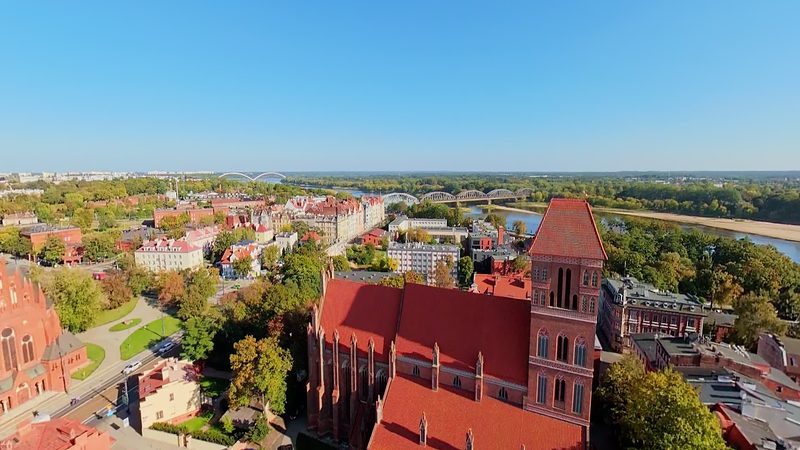
New Town and St James' Church, Toruń — a guided 360° flight
- 5 min
- 360° · 8K
- Open captions
- Online since 22 October 2026
In 1703 the Swedes looted the largest bells of St James' Church in Toruń; one of them is now in Uppsala Cathedral.
About the film
In this film I fly over Toruń's New Town and Jakubskie Przedmieście: from the fortress's former provisions warehouse on Dominikańska Street, past the churches of St Stephen, the Holy Trinity, St James and St Catherine, to the railway bridge and Toruń Miasto station. The New Town's streets run around the market square like a chessboard.
The guide talks, among other things, about Ernest Malinowski, after whom Toruń's railway bridge is named and whose monument stands on the Ticlio Pass, the highest point of his railway in the Andes. One more story from the film: Emperor Wilhelm II attended the consecration of St Catherine's Church, built for Protestant soldiers, in 1897.
If you are ever in Toruń, look at the towers by the railway bridge abutments. They once held statues of Frederick the Great, Emperor Wilhelm I and the Teutonic masters Hermann Balk and Hermann von Salza.
Places in the film
- Provisions Warehouse Map
- St Stephen's Church Map
- New Town Market Square Map
- St James' Church Map
- St Catherine's Church Map
- Ernest Malinowski railway bridge Map
- Toruń Miasto station Map
The guide's full text (English)
The fortress Provisioning Warehouse at Dominikańska 9 stands where, in 1685, fire destroyed Mateusz Brandtner's nearly finished organ in the Dominican friary church, and he built another. Small dormers line the long red roof.
In August 1903 bells paid for by Julius Holder-Egger were hung in the tower of St. Stephen Church; days later the ground under the vault gave way, but the work went on after repairs. Its dark spire rises beside us.
Around us the streets of the New Town run as a regular chessboard around the market, and only a single street breaks the grid: Wielkie Garbary, where houses had already gone up before the plan.
The Dominicans came to Toruń under a privilege from the Teutonic grand master Anno von Sangershausen in 1263 and were given land outside the town; a year later the New Town was founded, and they ended up inside it.
The Old Town lies across the rooftops. There, the way along Różana Street was cut through only in the early twentieth century; before that, today's Kopernika Street was the only road west out of town.
East of the walls, a new workers' quarter of Jakubskie Przedmieście grew up in the nineteenth century between Pułaskiego and Targowa streets, built mostly of half-timbered houses in the Prussian-wall style.
Karl Friedrich Schinkel designed the Church of the Holy Trinity, and while it was being built, an accident in the year 1820 cost lives. Its pointed red tower rises from the square.
Among the New Town's many inns, the Gospoda Murarska, the Masons' Inn, stood on the New Town Market Square, the old Neustädter Markt, and in the sixteenth century a Dom Weselny, a wedding house, opened here.
In the year 1703, during the Great Northern War, Swedish troops looted the biggest bells of the Church of Saint James the Apostle; a bell from that haul now sits in Uppsala Cathedral. Its tower wears a steep double roof.
Interwar planners meant Jakubskie Przedmieście, the suburb ahead of us, to become an industrial district; a starch factory went up there between the wars, now part of Cereal Partners, and work began on a new gasworks.
St. Catherine church was built for Protestant soldiers, who until then had prayed in a church in the Old Town, and when it was consecrated in the year 1897, Emperor Wilhelm II was present. Its green spire towers overhead.
In 1999, the year Toruń's railway bridge took Ernest Malinowski's name, a monument to him rose at Ticlio, the highest point of his railway line across the Andes, calling him a Polish engineer and Peruvian patriot.
During the war, the German occupiers planned to move the Toruń Miasto station and looked at new sites, among them Szosa Lubicka and Sobieskiego Street near a humpbacked bridge.
On the towers at each end of the Malinowski bridge stood statues: Frederick the Great and Kaiser Wilhelm the First on the far bank, and the Teutonic masters Hermann Balk and Hermann von Salza on the town side.
The present building of the Dworzec PKP Toruń Miasto, the town station, went up in the year 1889, and in January 1920 Polish troops marching into Toruń were welcomed here. Its cream walls stretch along the tracks.
Toruń's road bridge named after Józef Piłsudski, upriver from here, was assembled from a dismantled railway bridge that once stood at Opalenie near Kwidzyn, and only then was it opened to road traffic.
How the film was made
8K (7680×3840), 60 fps. Open captions in English, burned into the picture: three copies around the view, one next to the place being described. Narration: a synthetic voice in English.
The guide's facts come from:
- Wikipedia (Polish): Kościół św. Jakuba w Toruniu
- Wikipedia (Polish): Magazyn Prowiantowy Twierdzy Toruń
- Wikipedia (Polish): Kościół św. Szczepana w Toruniu
- Wikipedia (Polish): Kościół św. Katarzyny w Toruniu
- Wikipedia (Polish): Rynek Nowomiejski w Toruniu
- Wikipedia (Polish): Most kolejowy im. Ernesta Malinowskiego w Toruniu
- Wikipedia (Polish): Ernest Malinowski
Back to all filmsFor the cityFilms for deaf and hard-of-hearing viewers
Andrii Shramko
Engineer and filmmaker, living in Bydgoszcz. I have been filming 360° in motion since 2015.