Told from Above · серия Shramko 360
 Автор: Андрей Шрамко
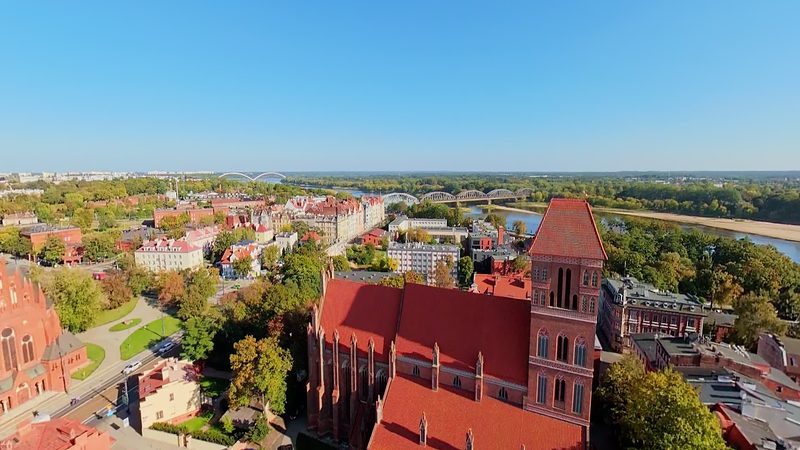
Новый город и костёл святого Якуба, Торунь — полёт 360° с гидом
- 5 мин
- 360° · 8K
- Открытые субтитры
- Онлайн с 22 октября 2026 г.
В 1703 году шведы забрали как трофей самые большие колокола торуньского костёла святого Якуба; один из них сегодня в соборе Уппсалы.
О фильме
В этом фильме я пролетаю над торуньским Новым городом и Якубским предместьем: от бывшего провиантского склада крепости на улице Доминиканской, мимо костёлов святого Стефана, Святой Троицы, святого Якуба и святой Екатерины, до железнодорожного моста и вокзала Toruń Miasto. Улицы Нового города ложатся вокруг рынка шахматной доской.
Гид рассказывает, в частности, об Эрнесте Малиновском, чьё имя носит торуньский железнодорожный мост, а памятник стоит на перевале Тиклио — высшей точке его железной дороги в Андах. Ещё одна история из фильма: в 1897 году на освящении костёла святой Екатерины, построенного для солдат-протестантов, присутствовал кайзер Вильгельм II.
Если приедете в Торунь, посмотрите на башни у береговых опор железнодорожного моста. Когда-то в них стояли статуи Фридриха Великого, кайзера Вильгельма I и магистров Тевтонского ордена Германа Балька и Германа фон Зальцы.
Места в фильме
- Провиантский склад (Magazyn Prowiantowy) Карта
- Костёл святого Стефана Карта
- Рынок Нового города (Rynek Nowomiejski) Карта
- Костёл святого Якуба Карта
- Костёл святой Екатерины Карта
- Железнодорожный мост имени Эрнеста Малиновского Карта
- Вокзал Toruń Miasto Карта
Полный текст гида (на английском)
The fortress Provisioning Warehouse at Dominikańska 9 stands where, in 1685, fire destroyed Mateusz Brandtner's nearly finished organ in the Dominican friary church, and he built another. Small dormers line the long red roof.
In August 1903 bells paid for by Julius Holder-Egger were hung in the tower of St. Stephen Church; days later the ground under the vault gave way, but the work went on after repairs. Its dark spire rises beside us.
Around us the streets of the New Town run as a regular chessboard around the market, and only a single street breaks the grid: Wielkie Garbary, where houses had already gone up before the plan.
The Dominicans came to Toruń under a privilege from the Teutonic grand master Anno von Sangershausen in 1263 and were given land outside the town; a year later the New Town was founded, and they ended up inside it.
The Old Town lies across the rooftops. There, the way along Różana Street was cut through only in the early twentieth century; before that, today's Kopernika Street was the only road west out of town.
East of the walls, a new workers' quarter of Jakubskie Przedmieście grew up in the nineteenth century between Pułaskiego and Targowa streets, built mostly of half-timbered houses in the Prussian-wall style.
Karl Friedrich Schinkel designed the Church of the Holy Trinity, and while it was being built, an accident in the year 1820 cost lives. Its pointed red tower rises from the square.
Among the New Town's many inns, the Gospoda Murarska, the Masons' Inn, stood on the New Town Market Square, the old Neustädter Markt, and in the sixteenth century a Dom Weselny, a wedding house, opened here.
In the year 1703, during the Great Northern War, Swedish troops looted the biggest bells of the Church of Saint James the Apostle; a bell from that haul now sits in Uppsala Cathedral. Its tower wears a steep double roof.
Interwar planners meant Jakubskie Przedmieście, the suburb ahead of us, to become an industrial district; a starch factory went up there between the wars, now part of Cereal Partners, and work began on a new gasworks.
St. Catherine church was built for Protestant soldiers, who until then had prayed in a church in the Old Town, and when it was consecrated in the year 1897, Emperor Wilhelm II was present. Its green spire towers overhead.
In 1999, the year Toruń's railway bridge took Ernest Malinowski's name, a monument to him rose at Ticlio, the highest point of his railway line across the Andes, calling him a Polish engineer and Peruvian patriot.
During the war, the German occupiers planned to move the Toruń Miasto station and looked at new sites, among them Szosa Lubicka and Sobieskiego Street near a humpbacked bridge.
On the towers at each end of the Malinowski bridge stood statues: Frederick the Great and Kaiser Wilhelm the First on the far bank, and the Teutonic masters Hermann Balk and Hermann von Salza on the town side.
The present building of the Dworzec PKP Toruń Miasto, the town station, went up in the year 1889, and in January 1920 Polish troops marching into Toruń were welcomed here. Its cream walls stretch along the tracks.
Toruń's road bridge named after Józef Piłsudski, upriver from here, was assembled from a dismantled railway bridge that once stood at Opalenie near Kwidzyn, and only then was it opened to road traffic.
Как сделан фильм
8K (7680×3840), 60 кадров/с. Открытые субтитры на английском впечатаны в изображение: три копии вокруг обзора, одна — рядом с местом, о котором идёт речь. Озвучка — синтетический голос на английском.
Факты гида взяты из:
- Википедия (на польском): Kościół św. Jakuba w Toruniu
- Википедия (на польском): Magazyn Prowiantowy Twierdzy Toruń
- Википедия (на польском): Kościół św. Szczepana w Toruniu
- Википедия (на польском): Kościół św. Katarzyny w Toruniu
- Википедия (на польском): Rynek Nowomiejski w Toruniu
- Википедия (на польском): Most kolejowy im. Ernesta Malinowskiego w Toruniu
- Википедия (на польском): Ernest Malinowski
Ко всем фильмамДля администрации городаФильмы для глухих и слабослышащих
Андрей Шрамко
Инженер и кинематографист, живу в Быдгоще. Снимаю 360° в движении с 2015 года.