Серія «Told from Above»
 Автор: Андрій Шрамко
Костели святої Катерини і святого Якова, Торунь — політ 360° з гідом
- 4 хв
- 360° · 8K
- Субтитри на екрані
- Онлайн з 28 жовтня 2026 р.
Перший польський сезон у торунському театрі відкрили лише в листопаді 1920 року «Помстою» Фредра, у присутності прем'єра Вінцентія Вітоса.
Про фільм
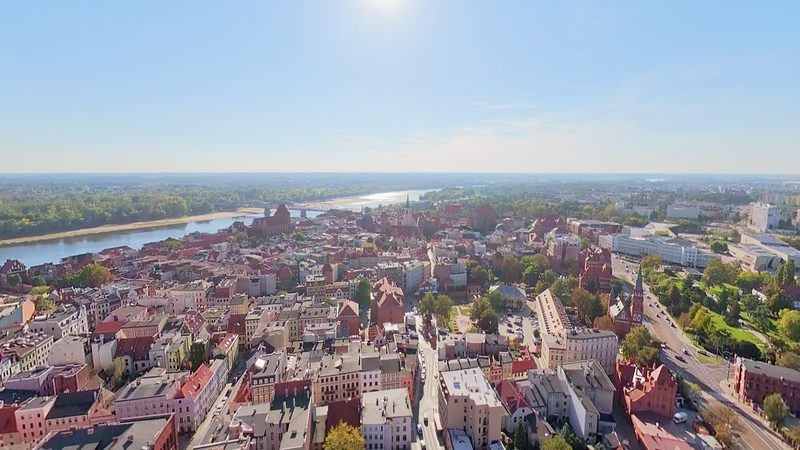
У цьому фільмі я пролітаю над торунським Новим містом і Валами: від костелів святої Катерини і святого Якова через Провіантський склад і костел святого Стефана до театру імені Вілама Хожиці, Йорданок, центру сучасного мистецтва «Znaki Czasu» і Collegium Maius.
Гід розповідає, зокрема, про скромну каплицю святої Катерини, збудовану близько 1360 року й розібрану за наказом пруської влади 1814 року, про легенду органа францисканця Павла Венхена і про Мар'яна Лалевича, автора будівлі Сільськогосподарського банку, якого німці розстріляли під час Варшавського повстання. 1945 року до костелу святого Стефана потрапили дзвони зі зруйнованої євангелічної церкви в Подгужі.
Якщо приїдете до Торуня, роздивіться зблизька зал на Йорданках. Світлий бетон там місцями «тріснув», щоб відкрити цегляно-червоне пікадо, — уклін торунській готиці.
Місця у фільмі
- Костел святої Катерини Мапа
- Костел святого Якова Мапа
- Театр імені Вілама Хожиці Мапа
- Концертна зала «Йорданки» (CKK Jordanki) Мапа
- Центр сучасного мистецтва «Znaki Czasu» Мапа
- Collegium Maius UMK Мапа
- Вали генерала Сікорського Мапа
Повний текст гіда (англійською)
Of all the gates and towers that once walled Nowe Miasto, the New Town below us, none survives; only the footings of a lost gate were found, facing the Old Town's Kotlarska Gate.
St. Catherine church continues an older, far more modest church of the same saint, raised around 1360 where the road left the New Market eastward; 1814 saw it demolished on Prussian orders. Red brick, green spire.
Legend has it that Kościół św. Jakuba had among Pomerania's earliest organs, built by the Franciscan Paweł Wenchen, who later built organs at Saint Peter's in Rome. Look for its square Gothic tower.
Bruno Gauer, the city's building councillor, is credited with this home for the town fire brigade, which moved here out of the town hall; today it is Komenda Wojewódzka Państwowej Straży Pożarnej. Brick, with a corner tower.
In 1743 Georg Friedrich Steiner drew the Dominican monastery on this spot, and his drawings, with the archaeologists' digs, are all that show how it looked. Dominikańska 9 is the white building there now.
In August 1945 Kościół Świętego Szczepana took the name of Saint Stephen; that same year it gained the peal of the war-wrecked Evangelical church in Podgórz. Look for its dark spire.
After the war the house at Wały Generała Władysława Sikorskiego 10 served the Milicja Obywatelska, and in 2016 a plaque went up there for anti-communist opposition activists once held inside. Brick, with a stepped gable.
The former Artillery Arsenal of Twierdza Toruń, the city's fortress, was to house the ethnographic museum that the town council resolved to found, and the museum acquired it after the war. White walls, black timber gable.
In 2010, at the World Architecture Festival in Barcelona, the design for the concert hall of Centrum Kulturalno-Kongresowe Jordanki won a prize as the best cultural building of the future. Look for its pale, angular walls.
In its early years Teatr im. Wilama Horzycy staged only German plays; the first Polish season opened in November 1920 with Fredro's Zemsta, with Prime Minister Wincenty Witos in the audience. The white theatre has curving gables.
Pale concrete, cracked open to show brick-red pikado, concrete with crushed brick chipped after setting, gives a nod to Toruń's Gothic; the consortium led by Mostostal Warszawa built Centrum Kulturalno-Kongresowe Jordanki. Beige, slanting walls.
Edward Lach shaped Centrum Sztuki Współczesnej Znaki Czasu as brick modules forming a square about 49 metres a side, and among them a glass-walled cylinder holds a winding staircase. Brick, around inner courtyards.
The BNP Paribas Polska building, first owned by the Państwowy Bank Rolny, is the work of Marian Lalewicz. During the Warsaw Uprising, German units shot Lalewicz in a mass killing on Dzika Street. Look for tall modernist windows.
Collegium Maius was a military hospital in the First World War, then the Pomeranian Urząd Wojewódzki.
Як створено фільм
8K (7680×3840), 60 кадрів/с. Відкриті субтитри англійською — три копії довкола, одна біля місця, про яке розповідає гід. Озвучення: синтезований голос (англійською).
Факти гіда — з джерел:
- Вікіпедія (польською): Teatr im. Wilama Horzycy w Toruniu
- Вікіпедія (польською): Kościół św. Katarzyny w Toruniu
- Вікіпедія (польською): Kościół św. Jakuba w Toruniu
- Вікіпедія (польською): Kościół św. Szczepana w Toruniu
- Вікіпедія (польською): Centrum Kulturalno-Kongresowe Jordanki
- Вікіпедія (польською): Centrum Sztuki Współczesnej Znaki Czasu
- Вікіпедія (польською): Budynek przy ul. Wały gen. Sikorskiego 15 w Toruniu
Усі фільми про містоДля міської владиФільми із субтитрами для глухих і людей зі зниженим слухом
Андрій Шрамко
Інженер і кінематографіст, живу в Бидгощі. 360° у русі знімаю з 2015 року.