Told from Above · a Shramko 360 series
 Author: Andrii Shramko
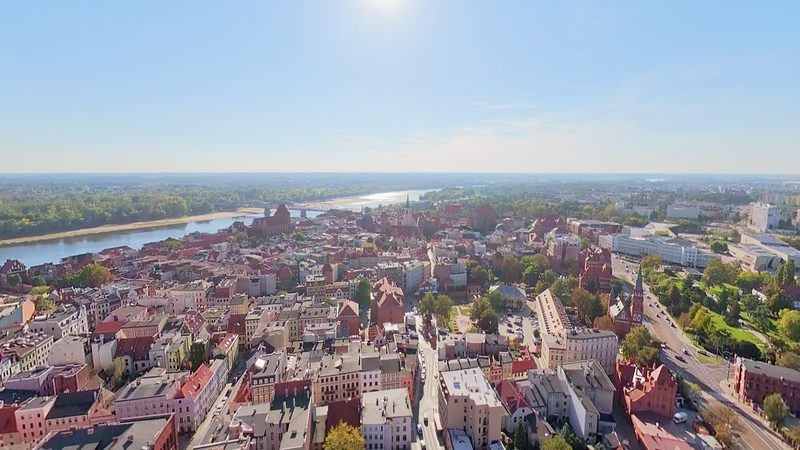
St Catherine's and St James' Churches, Toruń — a guided 360° flight
- 4 min
- 360° · 8K
- Open captions
- Online since 28 October 2026
The first Polish season at the Toruń theatre opened only in November 1920, with Fredro's "Zemsta", in the presence of Prime Minister Wincenty Witos.
About the film
In this film I fly over Toruń's New Town and the Wały, the old ramparts: from the churches of St Catherine and St James past the Provisions Warehouse and St Stephen's Church to the Wilam Horzyca Theatre, Jordanki, the Znaki Czasu contemporary art centre and Collegium Maius.
The guide talks, among other things, about the modest St Catherine's Chapel from around 1360, pulled down on Prussian orders in 1814, the legend of the organ built by the Franciscan Paweł Wenchen, and Marian Lalewicz, architect of the Agricultural Bank, shot by the Germans during the Warsaw Uprising. In 1945 St Stephen's Church received the bells of a ruined Protestant church in Podgórz.
If you are ever in Toruń, see the Jordanki hall up close. The pale concrete is "cracked" in places to reveal brick-red roughcast, a nod to Toruń's Gothic.
Places in the film
- St Catherine's Church Map
- St James' Church Map
- Wilam Horzyca Theatre Map
- Jordanki concert hall Map
- Znaki Czasu art centre Map
- Collegium Maius Map
- Wały gen. Sikorskiego (ramparts) Map
The guide's full text (English)
Of all the gates and towers that once walled Nowe Miasto, the New Town below us, none survives; only the footings of a lost gate were found, facing the Old Town's Kotlarska Gate.
St. Catherine church continues an older, far more modest church of the same saint, raised around 1360 where the road left the New Market eastward; 1814 saw it demolished on Prussian orders. Red brick, green spire.
Legend has it that Kościół św. Jakuba had among Pomerania's earliest organs, built by the Franciscan Paweł Wenchen, who later built organs at Saint Peter's in Rome. Look for its square Gothic tower.
Bruno Gauer, the city's building councillor, is credited with this home for the town fire brigade, which moved here out of the town hall; today it is Komenda Wojewódzka Państwowej Straży Pożarnej. Brick, with a corner tower.
In 1743 Georg Friedrich Steiner drew the Dominican monastery on this spot, and his drawings, with the archaeologists' digs, are all that show how it looked. Dominikańska 9 is the white building there now.
In August 1945 Kościół Świętego Szczepana took the name of Saint Stephen; that same year it gained the peal of the war-wrecked Evangelical church in Podgórz. Look for its dark spire.
After the war the house at Wały Generała Władysława Sikorskiego 10 served the Milicja Obywatelska, and in 2016 a plaque went up there for anti-communist opposition activists once held inside. Brick, with a stepped gable.
The former Artillery Arsenal of Twierdza Toruń, the city's fortress, was to house the ethnographic museum that the town council resolved to found, and the museum acquired it after the war. White walls, black timber gable.
In 2010, at the World Architecture Festival in Barcelona, the design for the concert hall of Centrum Kulturalno-Kongresowe Jordanki won a prize as the best cultural building of the future. Look for its pale, angular walls.
In its early years Teatr im. Wilama Horzycy staged only German plays; the first Polish season opened in November 1920 with Fredro's Zemsta, with Prime Minister Wincenty Witos in the audience. The white theatre has curving gables.
Pale concrete, cracked open to show brick-red pikado, concrete with crushed brick chipped after setting, gives a nod to Toruń's Gothic; the consortium led by Mostostal Warszawa built Centrum Kulturalno-Kongresowe Jordanki. Beige, slanting walls.
Edward Lach shaped Centrum Sztuki Współczesnej Znaki Czasu as brick modules forming a square about 49 metres a side, and among them a glass-walled cylinder holds a winding staircase. Brick, around inner courtyards.
The BNP Paribas Polska building, first owned by the Państwowy Bank Rolny, is the work of Marian Lalewicz. During the Warsaw Uprising, German units shot Lalewicz in a mass killing on Dzika Street. Look for tall modernist windows.
Collegium Maius was a military hospital in the First World War, then the Pomeranian Urząd Wojewódzki.
How the film was made
8K (7680×3840), 60 fps. Open captions in English, burned into the picture: three copies around the view, one next to the place being described. Narration: a synthetic voice in English.
The guide's facts come from:
- Wikipedia (Polish): Teatr im. Wilama Horzycy w Toruniu
- Wikipedia (Polish): Kościół św. Katarzyny w Toruniu
- Wikipedia (Polish): Kościół św. Jakuba w Toruniu
- Wikipedia (Polish): Kościół św. Szczepana w Toruniu
- Wikipedia (Polish): Centrum Kulturalno-Kongresowe Jordanki
- Wikipedia (Polish): Centrum Sztuki Współczesnej Znaki Czasu
- Wikipedia (Polish): Budynek przy ul. Wały gen. Sikorskiego 15 w Toruniu
Back to all filmsFor the cityFilms for deaf and hard-of-hearing viewers
Andrii Shramko
Engineer and filmmaker, living in Bydgoszcz. I have been filming 360° in motion since 2015.