Seria „Told from Above”
 Autor: Andrii Shramko
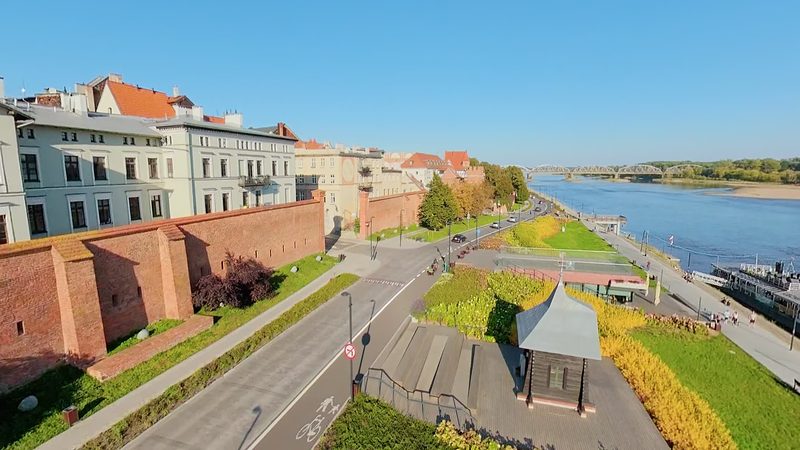
Bulwar Filadelfijski i Brama Żeglarska, Toruń — lot 360° z przewodnikiem
- 5 min
- 360° · 8K
- Napisy na ekranie
- Online od 24 października 2026
Torunianie w 1454 roku zdobyli zamek krzyżacki i wysadzili jego główną wieżę — dziś z zamku zostały ruiny.
O filmie
W tym filmie lecę nad Bulwarem Filadelfijskim, wzdłuż murów Starego Miasta: obok Bramy Żeglarskiej, Spichrza Szwedzkiego, Baszty Żuraw i Bramy Mostowej aż do ruin Zamku Krzyżackiego.
Przewodnik opowiada m.in. o porcie, który od średniowiecza przyjmował statki morskie, o tym, dlaczego od strony Wisły wystarczył jeden mur bez fosy, i o tym, kto naprawdę zbudował Spichrz Szwedzki. Legenda przypisuje go Szwedom z czasów potopu, a w rzeczywistości postawił go w 1719 roku toruński kupiec zbożowy Johann Nogge.
Kto przyjedzie do Torunia, niech zacznie spacer od Bramy Żeglarskiej. Tu burmistrzowie i rada miasta witali królów, a stąd Droga Królewska prowadziła w górę do miasta.
Miejsca w filmie
- Bulwar Filadelfijski Mapa
- Brama Żeglarska Mapa
- Spichrz Szwedzki Mapa
- Baszta Żuraw Mapa
- Brama Mostowa Mapa
- Ruiny Zamku Krzyżackiego Mapa
Pełny tekst przewodnika (EN)
The mayors and the town council welcomed kings and distinguished guests before Brama Żeglarska, the Sailors' Gate. The red-brick gate has white niches. From here the Via Regia, Droga Królewska, the Royal Road, led up into town.
In honour of Philadelphia, Toruń's partner city in America, the old Nadbrzeżna, the Riverside Street, or Uferstraße in German, was renamed Bulwar Filadelfijski: the quay on the right bank of the Vistula.
In 1242 Toruń held off a raid by Świętopełk, most likely behind ramparts of earth and timber. Brick walls followed, and a stretch from that time, behind us to the west, is the oldest surviving town wall in Poland.
New pavilions on Bulwar Filadelfijski stirred a quarrel: the general conservator of monuments, Jarosław Sellin, warned that they could break the integrity and authenticity of the Old Town panorama, and so endanger Toruń's UNESCO status.
Legend says the Swedes built Spichrz Szwedzki, the Swedish Granary, during the Deluge; in reality the Toruń grain merchant Johann Nogge had it built in 1719. Its white wall carries the word HOTEL.
Sea-going ships once came to Bulwar Filadelfijski: from the Middle Ages a port worked here, taking in sea-going vessels that sailed on to Warsaw, Gdynia and Gdańsk, among other places.
Film crews have worked on Bulwar Filadelfijski too: Marek Piwowski shot scenes of his film Rejs on this quay, and Ludzie Wisły, People of the Vistula, was filmed here as well.
Before any bridge was built, Brama Mostowa was called Brama Promowa or Przewoźna, the Ferry Gate. Its later name comes from the wooden bridge across the Vistula that it led to. Its battlemented brick tower rises ahead.
In 1823 Baszta Żuraw, the Crane Tower, was extended and joined to the Swedish Granary behind it. The tower takes its name from its job. A wooden crane in its attic still keeps its mechanism.
In 1432 the town's builder, Hans Gotland, raised Brama Mostowa, the Bridge Gate, on the site of an older gate. In the 1870s it became the centre point for setting out the ring of the Toruń fortress.
When dead swans infected with bird flu turned up on Bulwar Filadelfijski, a temporary bird flu monument followed: a gold-painted pipe topped with a straw swan, a nod to Stanisław Bareja's film Miś.
Facing the Vistula, Wisła, Toruń built only a single wall with no moat, as the Vistula was defence enough. Of Toruń's eight gates, the three that survive all face the Vistula.
For the 500th anniversary of Mikołaj Kopernik's birth, in 1973, Toruń reshaped its riverside: the old port quay was pulled down, and the boulevard along the Vistula was built in its place.
The brotherhood of St George built Dwór Bractwa Świętego Jerzego beside the Warte, the castle's south-west corner tower, after the townspeople had destroyed the castle of the Teutonic Order, the Deutscher Orden. They probably used bricks from the ruin.
In 1454 the knights' commander, Albrecht Kalb, refused to surrender the castle, and the townspeople attacked. Zamek Krzyżacki is the ruin beyond the flat roof. Next day the knights gave in, and the townspeople blew up the main tower.
Jak powstał film
8K (7680×3840), 60 kl./s. Napisy otwarte po angielsku — trzy kopie dookoła, jedna przy opisywanym miejscu. Narracja: głos syntetyczny (EN).
Fakty przewodnika — ze źródeł:
Wszystkie filmy o mieścieDla urzędu miastaFilmy z napisami dla osób niesłyszących
Andrii Shramko
Inżynier i filmowiec, mieszkam w Bydgoszczy. 360° w ruchu filmuję od 2015 r.