Told from Above · a Shramko 360 series
 Author: Andrii Shramko
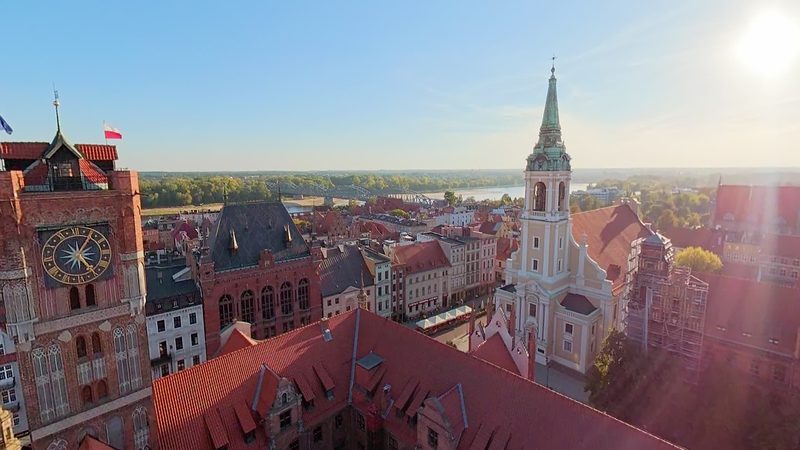
Old Town Market Square and Town Hall, Toruń — a guided 360° flight
- 4 min
- 360° · 8K
- Open captions
- Online since 26 October 2026
Copernicus was baptised in Toruń's cathedral in 1473, but which house he was born in was argued over for years.
About the film
In this film I fly over the Old Town Market Square in Toruń, over the town hall roof and on along Ducha Świętego Street to the walls by the Vistula.
The guide tells, among other things, how the Second Peace of Toruń, which gave Poland Gdańsk Pomerania and access to the sea, was sworn in Artus Court in 1466, about a tram the merchants ran right across the Market Square, and what the defenders of the Monastery Gate poured on attackers: hot porridge or oil. One more story from the film: the long white building with dormers is often called the New Arsenal, but it was the food store of Toruń Fortress.
If you are ever in Toruń, test yourself at the Leaning Tower: legend says a sinner cannot keep their balance there.
Places in the film
- Old Town Market Square Map
- Old Town Hall Map
- Artus Court (Dwór Artusa) Map
- Copernicus House Map
- Monastery Gate (Brama Klasztorna) Map
- Leaning Tower (Krzywa Wieża) Map
The guide's full text (English)
Its nickname is wrong. The Provisioning Warehouse, long and white with dormers, gets called Nowy Arsenał, though it stored fortress food; Polmozbyt used it last century, and a renovation won it the title Obiekt Roku, Object of the Year.
The post office grew until it swallowed a hotel. For Poczta Główna, red brick with stepped gables, the postal directorate bought the hotel next door from Carl Plenz, and the architect Brock designed a wing with a telegraph tower.
Trams once ran straight across this square. Between the wars, merchants living around Rynek Staromiejski, the square with café umbrellas, had a tram line laid across it, though officials came to outnumber them around 1932.
Poland regained its coast by an oath sworn here. In 1466 the Second Peace of Toruń was sworn in Dwór Artusa, the red brick hall with pinnacles, returning Gdańsk Pomerania and the sea to Poland, plus Warmia.
This church had no tower until the end of the nineteenth century. A tower society collected slowly for the Church of the Holy Spirit, until a Berlin architects' competition chose Hugo Hartung, whose tower with the green spire then rose.
In 1473 Mikołaj Kopernik was baptised in Johanniskirche. Its tall gabled tower is red brick. A side chapel keeps a thirteenth-century font, supposedly the very one used to baptise Copernicus.
Anna Wazówna, sister of King Zygmunt III, lies in the Church of the Assumption of Our Lady, brick with turrets on its gable, yet she was buried here only eleven years after her death in 1625.
Copernicus's birthplace has wandered. Dom Kopernika, the Copernicus House, now means number 15, a Gothic house with a stepped gable, yet over the years number 17 and a corner house on Piekary street were also taken for it.
This town hall began as a place to trade. Ratusz Staromiejski, the clock tower over the rooftops, grew from a merchants' house with a cloth hall, licensed by the Prussian master Gerhard von Hirzberg, and a row of stalls.
A proverb sealed the fame of the gingerbread baked here, Poland's favourite once baking became a craft. It names the four best things in the country: Toruń piernik, Gdańsk vodka, a Warsaw shoe and a Kraków maiden.
Attackers here risked a shower of hot porridge. Brama Klasztorna, brick under a tall red roof, is named after a Benedictine convent outside the walls, and from a hole in its passage ceiling defenders poured hot groats or oil.
Legend blames a love affair. Krzywa Wieża, tilting in the wall, was supposedly a Teutonic knight's penance for meeting a merchant's daughter; sinners, they say, lose their balance beside it. In truth, loamy ground tilts this thirteenth-century tower.
How the film was made
8K (7680×3840), 60 fps. Open captions in English, burned into the picture: three copies around the view, one next to the place being described. Narration: a synthetic voice in English.
The guide's facts come from:
- Wikipedia (Polish): Dom Kopernika w Toruniu
- Wikipedia (Polish): Rynek Staromiejski w Toruniu
- Wikipedia (Polish): Ratusz Staromiejski w Toruniu
- Wikipedia (Polish): Dwór Artusa w Toruniu
- Wikipedia (Polish): Brama Klasztorna w Toruniu
- Wikipedia (Polish): Krzywa Wieża w Toruniu
- Wikipedia (Polish): Magazyn Prowiantowy Twierdzy Toruń
Back to all filmsFor the cityFilms for deaf and hard-of-hearing viewers
Andrii Shramko
Engineer and filmmaker, living in Bydgoszcz. I have been filming 360° in motion since 2015.